
Vaccination is the best way to keep yourself, your family, and your community healthy. While COVID19 vaccines have been found to be 94% effective at preventing you from getting sick with COVID19, it still may be possible to get, carry and transmit the virus.
In the meantime, it is important that even those who have been vaccinated continue to:
This winter, the Southern Oregon Career and Technical Education Consortium (SOCTEC/CTE) and the Southern Oregon STEM Hub/CC4All have been working with the ODE on the planning and roll-out of an ODE/CTE middle-school career exploration pilot. During the planning phase, ODE’s CTE Department was directed by the Oregon Chief Education Office to select five of the 17 CTE regions in the state and pilot the initiative in 25 middle-schools across the state. Southern Oregon was selected as one of these five regions and was tasked with selecting five of our middle schools to participate.
This pilot program pairs an aptitude/interest test for 7th and 8th grade students, with career exploration opportunities that support students’ results. Local SOESD representatives met with the Curriculum Directors, Superintendents, Principals, Career Counselors, and CTE and Core teachers from local middle and high schools to plan how this might to execute the program. The group selected a combination of the YouScience aptitude test along with the Southern Oregon Connections/Nepris platform.
Knowing that a pilot would have greater success in schools that were either smaller, or closely connected to their high school partners, and paying special attention to equity, the group noted five middle-schools that fit these priorities including Henley Middle School, Lost River Jr./Sr. High school, Prospect Charter School, Butte Falls Jr./Sr. High School, and Chiloquin Jr./Sr. high School. Each of these schools have CTE Programs of Study at their high schools, have large populations of under-represented students, have strong career counseling for their students, and are somewhat familiar with Southern Oregon Connections/Nepris.
Concept of the pilot:
During January, all 7th and 8th grade students at the middle-schools listed above will take the “middle-school” YouScience aptitude/interest test
During February, staffs from the middle and high schools will follow-up with the students, going over their test results, and noting potential careers where students have aptitudes and interests that they may not have considered, or knew about before
Initially, as a way of introducing students to different careers, they will be directed to explore Oregon Connections archived “tours” and “interviews”
Over the following 18 months STEM/CTE will plan and hold virtual, or in-person, career exploration events through Oregon Connections with leaders from regional companies that follow these students’ aptitudes and interests
If in-person restrictions allow, live events will also be held, highlighting regional education and job Pathway opportunities
Due to the nature of a pilot project and that there is further ODE funding planned over the coming years, SOESD will continue to “follow” these students, and more preceding them, through their high school “careers”, offering targeted career counseling support, and more career exploration/expanded curriculum opportunities. It SOESD’s hope that this will allow students to choose a career Pathway based upon their growing awareness of what careers are available in their own communities, and providing the information needed for staff to assist in closing the interest/skills gap between what they know of and what they have a growing aptitude for.
“By and large, in the past, districts everywhere have lacked a means to gather the information needed to provide student-centric career counseling that is not based upon student interest alone, relying only on what information of careers that students already knew of, or found out about on their own. Through this pilot, we hope to be able to note, then encourage a wider diversity of our students with the information that they will need to make more informed decisions about their futures,” says Brian Robin, SOESD CTE Regional Coordinator.
Southern Oregon’s regional (Jackson, Josephine, and Klamath counties) Science, Technology, Engineering, and Math (STEM) Hub has been invited to build local capacity for STEM through a grant opportunity with Oregon Community Foundation (OCF). OCF’s IGNITE grant seeks to ignite partnerships between business and education to advance opportunities for specific target populations in Career and Technical Education (CTE)-STEM: rural, low-income, students of color and girls.
To prepare for that opportunity, the Southern Oregon STEM Hub retained Dialogues in Action (DIA) to conduct a needs assessment. DIA developed an interview protocol and purposeful stratification, received input from the Guidance Group on valuable community members to interview, and interviewed a total of 34 individuals. Additionally, DIA conducted background data analysis on existing data on the region’s employment and education pathways and outcomes. Finally, the data findings were presented to a group of community leaders, who workshopped them, elevated the most salient points, and contributed to a series of possible responses to the needs assessment.
The following report provides a clear picture of the region’s employability and economic growth for high wage, high demand careers; available pathways and opportunities to increase access for target populations; and accessibility gaps and opportunities for industry and education to actively partner to strengthen pathways for target populations, leading to high wage, high demand jobs.
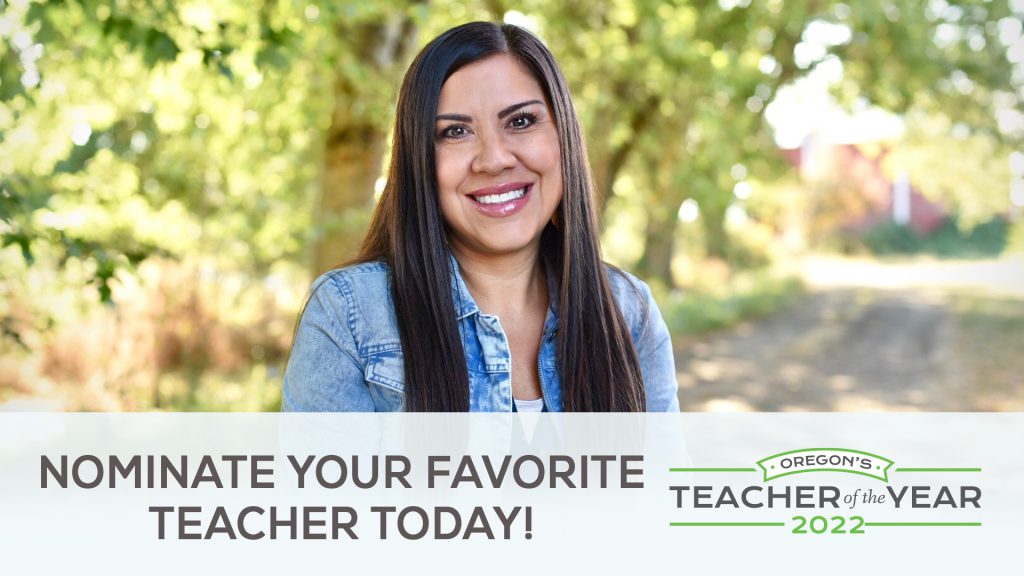
The Oregon Department of Education, in partnership with the Oregon Lottery, is pleased to announce the continuation of Oregon Regional Teacher of the Year to honor exemplary educators in every region of the state!
Nominations are open statewide through January 31, 2021
Teachers will submit their applications by March 27, 2021
Regional Teachers of the Year will be honored across the state in May 2021!
One of the Regional Teachers of the Year will be named the 2022 Oregon Teacher of the Year in September 2021!
Regional Teachers of the Year will receive a cash prize of $500 and will be celebrated across the state. The 2022 Oregon Teacher of the Year will receive a $5,000 cash prize (with a matching $5,000 going to their school!) and serve as a spokesperson and representative for all Oregon teachers.
Anyone can nominate a teacher! All Oregonians are encouraged to nominate their favorite teacher today at: oregonteacheroftheyear.org
Save To Calendar
Start: Friday April 2nd, 2021 at 01:00 PM
End: Friday April 2nd, 2021 at 04:00 PM
PDUs: 3.00
Instructor: Ricky Robertson Location: ZOOM
Save To Calendar
Start: Friday April 9th, 2021 at 01:00 PM
End: Friday April 9th, 2021 at 04:00 PM
PDUs: 3.00
Instructor: Ricky Robertson Location: ZOOM
Save To Calendar
Start: Friday April 16th, 2021 at 01:00 PM
End: Friday April 16th, 2021 at 04:00 PM
PDUs: 3.00
Instructor: Ricky Robertson Location: ZOOM
Save To Calendar
Start: Friday April 23rd, 2021 at 01:00 PM
End: Friday April 23rd, 2021 at 04:00 PM
PDUs: 3.00
Instructor: Ricky Robertson Location: ZOOM
In this four-part virtual workshop, presented over four mornings in November, December and January, renowned educator, consultant, coach and author Ricky Robertson will deepen participants’ understanding of trauma-informed behaviors, social-emotional supports and restorative practices as well as introduce strategies for implementation of the principles and practices in the classroom and schoolwide.To help foster a sense of community, participants should try to attend all four sessions as part of the workshop cohort; however, this workshop will repeat in April 2021, so a missed session can be made up later.Session 1 – Friday, April 2, 2021 – 1 pm to 4 pm
Schoolwide Trauma-Responsive Practices (Tier 1)
A trauma-informed approach is a schoolwide approach to supporting the social-emotional and behavioral needs of all students, especially those impacted by ACEs and trauma. In this virtual workshop, we will explore student behavior as a form of communication and develop classroom-based and schoolwide strategies to support students. Participants will deepen their understanding of relationship-based teaching and acquire skills to foster safety, trust, and belonging in their classrooms and schools. They will be introduced to strategies that support students’ abilities to communicate, problem-solve, regulate, and develop a sense of accountability and hope.Session 2 – Friday, April 9, 2021 – 1 pm to 4 pm
Trauma-Informed Social Emotional Learning
Social-emotional learning is a critical component of quality core instruction. To truly have an impact, social-emotional competencies must be integrated into daily classroom routines and management. Students’ social-emotional outcomes improve when they see healthy behaviors regularly modeled, practiced, and reinforced. In this session, participants will develop a plan for integrating culturally responsive and trauma-informed social-emotional learning competencies into their curriculum and instruction.Session 3 – Friday, April 16, 2021 – 1 pm to 4 pm
Trauma-Informed Restorative Practices
Trauma-informed schools respond to conflict in ways that build trust and accountability. In this virtual workshop, participants will be introduced to the fundamental principles of Restorative Practices. Participants will be introduced to Tier 1 community building circles for both staff and students. Then we will explore the core principles of Restorative Practices and some useful tools to engage in restorative dialogue and problem-solving. Participants will consider next steps for integrating these principles and practices into their classrooms and schools.Session 4 – Friday, April 23, 2021 – 1 pm to 4 pm
Teams & Teamwork for Sustained Implementation
To truly meet the needs of our students, we have to focus on long term implementation of trauma-informed behavioral and social-emotional supports. We cannot do this work alone, we need to work together with our colleagues, students, families, and community partners. This session will focus on teams and teamwork to support long-term implementation of trauma-informed practices and ways to assess their impact and build teachers’ collective efficacy in responding to the needs of their students. In many respects, this session is the most important one of the entire series. If we don’t have a system in place to monitor the impact of our efforts then there is no way to sustain and improve them.About Ricky Robertson: I am an educator, author, and consultant who has worked with alternative and traditional schools, serving students from grades preK-12 within urban, suburban, and semi-rural communities. I provide coaching, consultation, and multi-day professional development workshops to build systems of support for students impacted by Adverse Childhood Experiences (ACEs) and trauma, and the educators who work with them. I have a background in Restorative Justice/Practices, culturally responsive teaching, LGBTQ+ student advocacy, and trauma-informed practices for teaching and behavior management.
ZOOM
Interdisciplinary
Free to all educators within SOESD component districts
In this self-paced, multi-session online course (conducted through Canvas), participants will:
Familiarize with the original and ongoing Adverse Childhood Experiences (ACEs) studies
Identify types of ACEs
Understand the long-term, significant impacts of ACEs on children and families
Identify the impact ACEs can have on a student’s social, emotional, and academic development
Identify strategies and resources for prevention of ACEs in children
Identify strategies for supporting children with ACEs in the school/classroom
The class is limited to 25 participants per cohort. Registration closes at 4 pm on Friday, December 4, 2020. A confirmation email will be sent from Canvas to the first 25 registrants as educators are enrolled. Additional opportunities to take this course will continue to be offered throughout the school year.
Online
Interdisciplinary
Free to all educators within SOESD component districts
Nancy Hayes
5417768590
nancy_hayes@soesd.k12.or.us
In this self-paced, multi-session online course (conducted through Canvas), participants will:
Build upon the broad, foundational knowledge of trauma gained in courses, such as ACEs 101
Learn and discuss the six principles of trauma-informed approach in education
Gain an understanding of how vicarious trauma and neuroscience shapes learning AND teaching
Apply skills learned to implement tools for their classrooms, with colleagues and out in the community
Find out how to use simple strategies to combat compassion fatigue and counteract the stress in the workplace, especially during the pandemic
The class is limited to 25 participants per cohort. Registration closes at 4 pm on Friday, December 4, 2020. A confirmation email will be sent from Canvas to the first 25 registrants as educators are enrolled. Additional opportunities to take this course will continue to be offered throughout the school year.
Online
Interdisciplinary
Free to all educators within SOESD component districts
Nancy Hayes
5417768590
nancy_hayes@soesd.k12.or.us
Are you a parent of a 3 or 4 year old child?
¿Es padre de un niño de 3 o 4 años?
Do you live in Jackson or Josephine County?
¿Vives en el condado de Jackson o Josephine?
Would you like your child to attend a preschool at no cost to your family?
¿Le gustaría que su hijo asistiera a un preescolar sin costo para su familia?
To learn more about Preschool Promise:
Para obtener más información sobre Preschool Promise:
The Southern Oregon Early Learning Services Hub (SOELS) brings together partners in the sectors of early learning, K-12 education, health, social and human services, and private sector business to improve outcomes for families with children under the age of six. With better coordination and alignment of resources and services, our families become more healthy, stable and attached and our children arrive at kindergarten prepared and supported for success. SOESD generously provides the fiscal and administrative supports for SOELS.
Acerca del Centro de Servicios de Aprendizaje Temprano del Sur de Oregon
El Centro de Servicios de Aprendizaje Temprano del Sur de Oregón (SOELS) reúne a socios en los sectores de aprendizaje temprano, educación K-12, salud, servicios sociales y humanos y empresas del sector privado para mejorar los resultados de las familias con niños menores de seis años. Con una mejor coordinación y alineación de recursos y servicios, nuestras familias se vuelven más saludables, estables y unidas y nuestros niños llegan al jardín de infantes preparados y apoyados para el éxito. SOESD proporciona generosamente el apoyo fiscal y administrativo para SOELS.
For more information/ For assistance in Spanish/
Para más información: Para obtener ayuda en español:
René Brandon Lorena Juarez
Southern Oregon Early Learning Services Hub Child Care Resource Network